

If you’re a homeowner or gardener in Waxhaw, Matthews, or the surrounding Charlotte area, you’ve likely discovered that our local soil presents some unique challenges. The piedmont clay that dominates Union County and the greater Charlotte region is notoriously heavy, dense, and difficult to work with. This thick, compacted earth drains poorly, resists root penetration, and lacks the nutrient-rich organic structure that healthy lawns and gardens thrive in. The good news is that soil amendments offer a proven, practical solution to transform your landscape’s foundation.
Waxhaw’s humid subtropical climate and acidic soil conditions mean that many homeowners struggle with drainage issues, nutrient deficiencies, and turf that never quite reaches its potential. Whether you’re establishing a new lawn in Ballantyne, reviving a tired garden bed in Indian Trail, or preparing a hardscape project in Pineville, understanding which soil amendments to use and when to apply them is essential to success. This guide walks you through everything you need to know to amend your soil and create healthier, more productive landscapes throughout the Charlotte area.
Understanding Waxhaw’s Clay Soil and Why It Needs Amending
The soil beneath your feet in Waxhaw is part of the piedmont region’s geological makeup, composed primarily of dense clay with limited organic matter. This clay-heavy composition creates several problems that directly impact your lawn and garden’s health. Water doesn’t permeate easily through clay, leading to standing water after heavy rains and poor drainage during dry periods. Roots struggle to penetrate the hard, compacted layers, forcing trees, shrubs, and grass to develop shallow root systems that can’t access deep soil moisture during droughts.
Beyond drainage and compaction, Waxhaw’s piedmont soil tends to be moderately acidic, with pH levels typically falling between 5.5 and 6.5. While some plants prefer slightly acidic conditions, most turf grasses and popular ornamentals perform best in a more neutral pH range of 6.5 to 7.5. This acidity, combined with the clay’s nutrient-binding characteristics, makes it harder for plants to absorb essential elements like calcium, magnesium, and phosphorus, even when those nutrients are technically present in the soil. Over time, repeated harvesting of plants, water runoff, and natural leaching deplete what little topsoil exists, worsening the problem.
The harsh reality is that clay soil in its unmodified state simply won’t support the lush, healthy landscape most homeowners envision. Attempting to work clay without amendments is like trying to build on sand. This is why savvy landscapers and serious gardeners throughout Waxhaw, Stallings, Wesley Chapel, and Fort Mill routinely incorporate soil amendments as the foundation of their landscape strategy. An investment in improving your soil now pays dividends for years to come.
Types of Soil Amendments and What They Do
The universe of soil amendments is broad, but several proven options work exceptionally well in the Charlotte area. Understanding how each amendment functions helps you select the right tool for your specific soil problem. Compost is perhaps the most versatile amendment available, improving clay soil in multiple ways simultaneously. Composed of decomposed organic matter, quality compost adds humus that loosens clay particles, increases water-holding capacity, and introduces beneficial microorganisms that enhance nutrient cycling. When worked into clay-heavy soil, compost acts like a sponge, creating air pockets and improving overall soil structure.
Lime serves a specific and crucial role, particularly in Waxhaw’s acidic soil environment. Agricultural lime, also called ground limestone, raises soil pH and makes existing nutrients more available to plant roots. Lime works slowly, taking several weeks to months to fully dissolve and affect pH, which makes early application essential. Gypsum, by contrast, works differently and serves a different purpose. While lime raises pH, gypsum provides calcium without significantly altering acidity. Gypsum is particularly effective at breaking up clay particles and improving soil structure without the dramatic pH shift that lime creates. In many cases, Waxhaw landscapes benefit from both lime and gypsum applied strategically.
Sulfur operates opposite to lime, lowering soil pH in cases where your soil is too alkaline. While less common in Waxhaw since our native soil is already acidic, sulfur has its place in specific situations, particularly for plants that strongly prefer acidic conditions. Organic matter in forms like aged manure, leaf mold, and shredded hardwood bark adds carbon and gradually breaks down to improve soil structure. Peat moss, though increasingly criticized for environmental reasons, remains widely used for its water-retention properties, though coconut coir and other peat alternatives are gaining popularity. Specialty amendments like mycorrhizal fungi and beneficial bacteria colonies work at the microbial level, colonizing soil and improving nutrient uptake and disease resistance.
The key is matching the amendment to your soil’s specific deficiency. A soil test reveals whether your primary issue is pH, nutrient content, drainage, or compaction, allowing you to select amendments with precision rather than guessing.
Testing Your Soil pH and Identifying What Your Lawn Needs
Before investing in amendments, you must know your soil’s baseline characteristics. A professional soil test is the most reliable way to understand your specific situation. These tests measure pH, nutrient content (nitrogen, phosphorus, potassium), organic matter percentage, and other critical factors. For Waxhaw and surrounding areas, the NC State University Soil Testing Laboratory offers affordable, accurate analysis. The process is straightforward: collect soil samples from multiple locations across your property, mix them together, and submit the combined sample according to the lab’s instructions.
The results provide clear recommendations for which amendments to apply and in what quantities. This removes guesswork and prevents over-application of lime or other materials, which can create new problems. Home pH testing kits offer a budget-friendly alternative, though they’re less comprehensive than professional testing. These kits typically reveal whether your soil is acidic, neutral, or alkaline, giving you enough information to decide whether lime, sulfur, or neither is needed. Many local garden centers and landscape suppliers in Waxhaw, Matthews, and the greater Charlotte area offer soil testing kits and can recommend local professionals who perform in-depth analysis.
For gardeners seeking quick results, visual and tactile observations provide initial clues. If your clay soil forms a tight ball when squeezed, if water pools in your beds after rain, or if grass struggles to establish strong roots despite adequate moisture, you’re looking at a compaction and drainage problem best solved by compost and organic matter. If your grass is pale and stunted despite healthy moisture, you may have a pH or nutrient issue pointing toward lime and targeted fertilizer applications. The investment in a soil test, often costing just fifteen to thirty dollars, pays for itself many times over by preventing wasted money on inappropriate amendments.
When and How to Apply Soil Amendments for Best Results
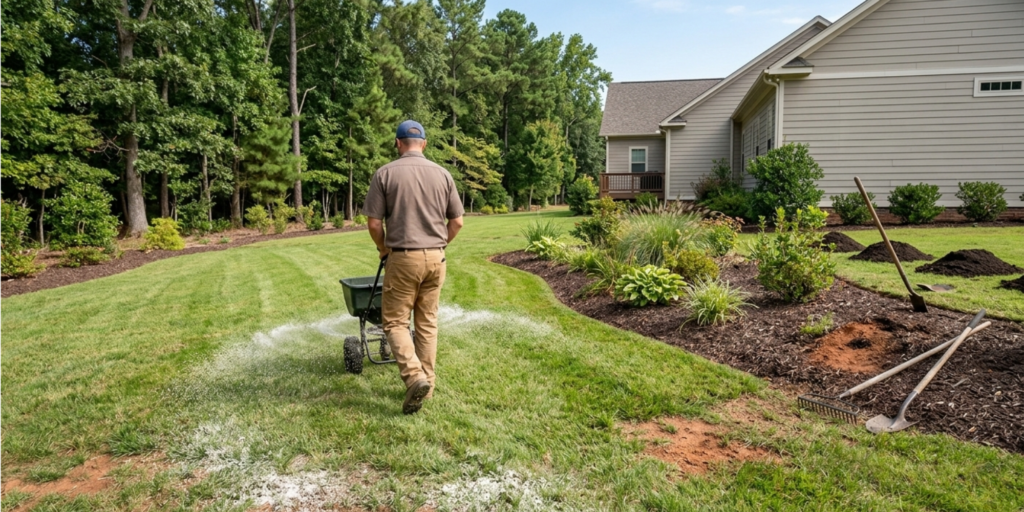
Timing dramatically affects amendment effectiveness. Fall is the ideal season for lime application in Waxhaw and the greater Charlotte area. Applying lime in fall, ideally September through November, gives the material months to dissolve and adjust soil pH before spring planting. Lime works slowly, typically requiring six to eight weeks to noticeably shift pH and make nutrients more available. Spring application is possible but less ideal, as you’ll be racing against a growing season already underway. Winter weather in the Charlotte area doesn’t inhibit lime’s action, so applying it during dormancy is perfectly effective.
Compost and organic amendments work best when incorporated in spring as soil warms and microbial activity accelerates, though fall application builds organic matter reserves for spring growth. Work amendments into the top six to eight inches of soil, the zone where most roots actively feed. Simply spreading compost on the surface helps, but tilling or spading it in produces far superior results. For established lawns where tilling isn’t practical, top-dressing with quality compost and allowing it to work down through natural watering and settling provides gradual improvement over multiple seasons. This approach is particularly useful in neighborhoods like Ballantyne, Weddington, and South Charlotte where large, established turf areas need enhancement without complete renovation.
Application rates vary by amendment and your soil test results, but general guidelines help. Lime application typically ranges from one to five tons per acre, depending on your pH target and starting acidity. For homeowner applications, this translates to fifty to two hundred pounds per one thousand square feet. Compost should be worked in at a depth of two to four inches for new beds or top-dressed at one to two inches for established lawns. Gypsum rates typically fall between five hundred and one thousand pounds per acre. Always follow your soil test recommendations and manufacturer guidance for specific products. Over-application doesn’t produce better results and can create imbalances that cause new problems.
Choosing the Right Amendments for Lawns Versus Garden Beds
While the underlying challenges of Waxhaw’s clay soil affect both lawns and gardens, your amendment strategy shifts slightly depending on your specific application. Lawns benefit primarily from compost top-dressing, lime for pH adjustment, and organic matter that gradually incorporates through natural processes. Since you can’t till a mature lawn, working compost into the top layer and allowing watering and earthworm activity to pull it down is the practical approach. A quarter to half-inch of quality compost top-dressed in fall and worked in with dethatching equipment provides slow but steady improvement without disrupting turf. Lime application on established lawns should be done when grass is dormant or during slow-growth periods to minimize stress.
Garden beds offer more flexibility since you’re typically establishing or refreshing the space anyway. Here, wholesale incorporation of compost, aged manure, and other organic materials works excellent. When creating new beds, mixing compost and organic matter to a depth of eight to twelve inches creates an ideal growing environment that mitigates clay’s worst characteristics. Gypsum works particularly well in perennial beds where you’re establishing plants for long-term occupancy, as the improved soil structure benefits root development over many seasons. Specialty amendments like peat moss or coconut coir help retain moisture in compacted clay without the bulk of compost, useful when space is limited or when creating specific planting pockets.
For vegetable gardens in Waxhaw and surrounding areas, a combination of lime for pH adjustment, compost for organic matter, and possibly sulfur for acid-loving plants like blueberries creates ideal conditions. Raised beds offer another strategy entirely, allowing you to import quality topsoil and completely avoid native clay. However, even raised beds benefit from lime incorporation if your water source is highly acidic or if you’re using materials harvested locally from acidic soil regions. The key is matching your amendment portfolio to your actual goals. A pristine Ballantyne lawn needs different treatment than a productive vegetable garden in Indian Trail or a perennial border in Wesley Chapel.
When to Call a Professional Soil Amendment Service
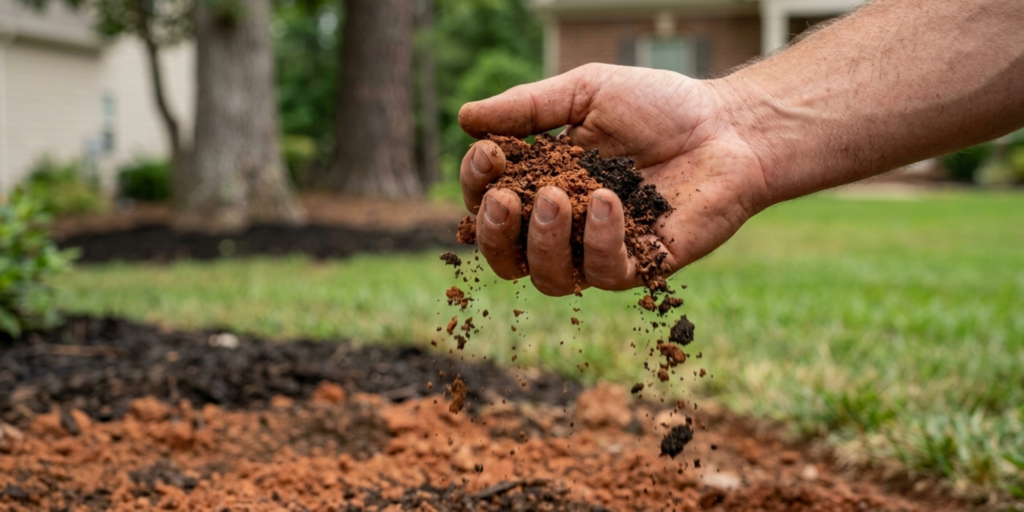
While many soil amendments can be applied by homeowners, professional landscape and hardscape contractors bring expertise and equipment that produce superior results, particularly for large-scale projects. Companies like JH Landscapes serving Waxhaw, Matthews, Marvin, Pineville, Monroe, Stallings, and the surrounding Charlotte area understand the specific challenges of piedmont soil and have tested strategies for addressing them. Professionals conduct or interpret soil testing, calculate appropriate amendment rates for your property’s specific conditions, and apply materials efficiently using equipment that ensures proper incorporation and consistency.
Particularly for projects involving new home construction, drainage solutions, major landscape renovation, or complex hardscape and patio installation, professional amendment work is well worth the investment. A landscape contractor can coordinate soil amendment timing with other work, ensuring amendments are applied before plants establish, when effectiveness is highest. They can also source quality materials locally and ensure consistent application across large areas. For properties in Indian Trail, Fort Mill, and beyond where soil conditions vary dramatically across the site, professional assessment and customized amendment plans prevent costly mistakes and produce landscapes that thrive from establishment.
Drainage issues, in particular, often require more than simple amendments. Standing water, root rot, and persistent soggy patches may point to hardscape solutions like French drains, rain gardens, or grading adjustments that complement soil amendment. JH Landscapes specializes in comprehensive drainage solutions throughout Waxhaw and the Charlotte area, combining soil amendment with engineered solutions for properties where simple amendments alone won’t solve the problem. Similarly, major projects like deck installation, pergola construction, or outdoor kitchen creation benefit from professional site preparation that includes proper soil amendment and compaction verification.
Frequently Asked Questions
How long does it take for lime to change my soil pH?
Lime typically begins affecting soil pH within six to eight weeks of application, though complete reaction and stabilization may take several months. This is why fall application is ideal in Waxhaw and the Charlotte area. Finely ground lime reacts more quickly than coarser agricultural lime. You can retest soil pH in spring to confirm changes and adjust future applications accordingly.
Can I apply too much compost to my garden beds?
Unlike lime or other mineral amendments, it’s virtually impossible to apply too much quality compost. More compost consistently produces better soil structure, water retention, and biological activity. The main practical limitation is availability and cost rather than any risk of over-application. Many successful gardeners in Waxhaw apply multiple inches of compost annually to maintain soil quality.
Should I use gypsum, lime, or both in my Waxhaw garden?
This depends on your soil test results and specific goals. Lime is essential if your soil pH is below 6.5 and you’re growing plants preferring neutral conditions. Gypsum is beneficial if you have clay compaction and good pH, or if you want calcium without pH change. Many Waxhaw properties benefit from both, applied at different times. Consult your soil test recommendations or contact a local landscape professional for customized guidance.
Is peat moss still the best amendment choice, or should I switch to alternatives?
Peat moss remains effective for moisture retention and organic matter, but environmental concerns make alternatives like coconut coir, compost, and aged bark increasingly popular. All work well in Waxhaw’s climate. Compost offers the broadest benefits. Coconut coir provides moisture retention similar to peat with lower environmental impact. The best choice depends on your specific needs and values.
How often do I need to apply soil amendments to maintain soil health?
Top-dressing with compost annually or every other year maintains organic matter in established lawns and gardens. Lime reapplication depends on pH and soil type, typically needed every three to five years in Waxhaw’s acidic environment. Regular soil testing every two to three years confirms whether amendments remain necessary or if your soil has improved enough to reduce applications.
Build the Foundation Your Landscape Deserves
Transforming your Waxhaw or Charlotte area landscape starts with healthy soil. Whether you’re dealing with the dense clay that plagues Union County, struggling with drainage in Stallings or Wesley Chapel, or planning a new hardscape project in Marvin or Fort Mill, professional soil amendment guidance makes the difference between average results and exceptional ones. JH Landscapes combines expertise in soil science with practical landscaping experience to create customized amendment plans that address your property’s specific challenges. From simple top-dressing to comprehensive site preparation for major construction, our team understands piedmont soil and knows exactly which amendments work best in our local climate and conditions.
Healthy soil isn’t a luxury — it’s the single most important investment you can make in your outdoor space. The right amendments applied at the right time create a resilient growing environment that supports everything from lush turf and vibrant garden beds to long-lasting hardscape installations. When your soil is right, everything else follows: stronger roots, better drainage, lower maintenance, and landscapes that look their best season after season. Let JH Landscapes help you get your soil right from the start, so every plant, path, and patio has the foundation it needs to thrive for years to come.
About JH Landscapes
JH Landscapes specializes in comprehensive outdoor living solutions with over 15 years of experience serving the Charlotte metro area, including Waxhaw, Fort Mill, and surrounding communities. We provide expert services such as landscape design, lawn care, and outdoor construction projects including covered patios, pergolas, and complete landscape transformations.
Our team of certified professionals combines technical expertise with landscape design knowledge to deliver seamless integration between hardscape elements and natural surroundings. We pride ourselves on using premium materials, professional installation techniques, and thorough project management to ensure every outdoor space meets our clients’ vision.
Contact JH Landscapes today at (704) 999-0976 to discuss your soil amendment and lawn care needs in Waxhaw.